Gin Rummy Masters: Card Game
- 4.6
- Rating
- 50.00K
- Installs
- Free
- Price

 Analysis by App-foxy
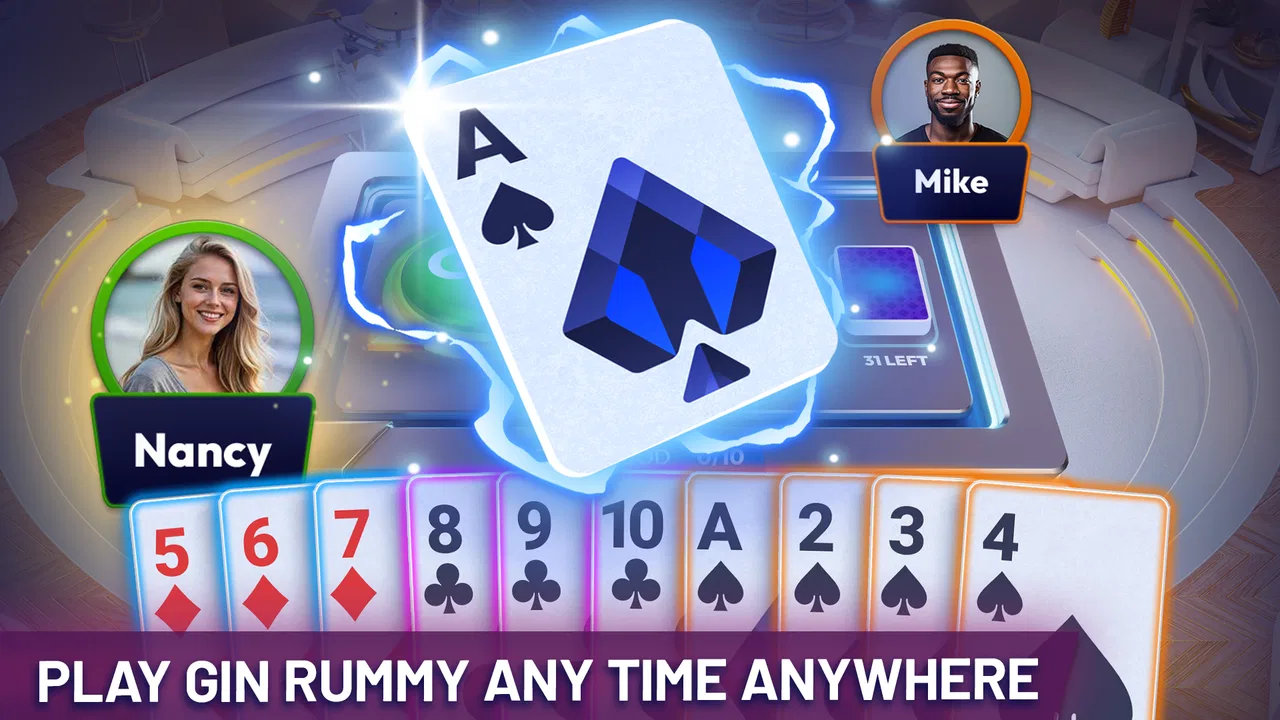
I spent my time with Gin Rummy Masters: Card Game focusing on the part that defines its identity: real-time Gin Rummy at a table with other players. That choice makes the game feel very different from a quiet, offline card app. Instead of treating each hand as a private puzzle, I had to make decisions while another person was also waiting, watching the pace, and trying to read the same discard pile. For anyone who already enjoys Gin Rummy, that live pressure is the main reason to try it.
This is a free card game from YallaPlay, rated for Everyone. It has a 4.6 average from around 2.9 thousand ratings, with more than 50 thousand installs, so it has already attracted a modest but visible audience. The current version is 2.32.8, and it runs on Android 7.0 or later. Those details make it accessible to people using older Android phones, although the experience still depends heavily on having a reliable connection when playing live.
Why the real-time table changes Gin Rummy
The most important capability here is not simply playing Gin Rummy on a phone. It is playing against a live opponent while the hand is unfolding. That changes the rhythm of every turn. In a standard solo card game, I can pause, reconsider a move, or leave the app open while doing something else. In a real-time match, hesitation has a social and practical cost: the table is moving, and my decision has to fit the moment.
You May Also Like

 Blood Strike: 2.5 Anniversary
Blood Strike’s Loadouts Turn Every Drop Into a Tactical Gamble
A close look at Blood Strike’s custom loadouts: how fast access to signature weapons reshapes its battle royale rhythm, rewards preparation, and narrows the gap between fights.

 Pandora - Music & Podcasts
Pandora’s Music Is Easy to Start, but Harder to Recover
Pandora’s strength is its low-effort path from a seed to a station. Its weak spot is how much confidence it asks you to place in connection, setup, and quiet recovery.

 8 Ball Pool
 Is Built on Rivalries, Rematches, and Routine
A close look at the rivalries, rematches, shared routines, and unanswered safety questions that turn a quick pool match into a persistent mobile community.

 Samsung Music
’s Quiet Strength Is Playing What You Already Own
Its reach comes less from spectacle than from dependable access to a personal library. That simplicity is both the app’s strongest retention engine and its ceiling.

 AccuWeather: Weather Radar
AccuWeather Review: A Quick, Clear Forecast for Everyday Decisions
For everyday plans, the best forecast is the one you can understand quickly. AccuWeather makes rain timing, radar, and local conditions easy to act on, with a few trade-offs.

 Hill Climb Racing
Why Hill Climb Racing Still Turns Crashes Into One More Run
A tiny car, a bumpy hill and one more upgrade: Hill Climb Racing keeps resurfacing because its simple chaos makes every near-miss feel personal.
More From Our News Desk
View All News


I noticed that this makes ordinary card choices more meaningful. Drawing from the stock is not only about improving my own hand. Discarding is also a message, even when I do not intend it to be one. A card that looks harmless may help the opponent complete a combination. A discard that seems too cautious can leave my hand clogged with cards that are unlikely to connect. Because another person is making decisions at the same time, I found myself paying closer attention to what had already appeared.
That is the real effect of the live format: it turns Gin Rummy from a purely mathematical exercise into a short contest of timing, memory, and inference. I still needed to build melds and reduce deadwood, but I also had to think about what the other player might be collecting. The game therefore rewards a different kind of concentration than a relaxed solitaire-style card app.
The store summary presents the game around friends, rewards, and a leaderboard. In practice, that framing points toward a competitive session rather than a casual card toy. I would not choose this game expecting a long campaign, a story, or a collection of unrelated modes. Its appeal is narrower and clearer: sit down, play Gin Rummy in real time, and see how well your decisions hold up against another person.
What a turn feels like in practice
The basic loop is familiar to anyone who knows Gin Rummy. I look at my hand, decide whether the available card helps, draw, and then discard. The challenge is that the best move is not always the card that creates the most obvious immediate combination. Sometimes I preferred keeping a flexible card because it could connect in more than one way. At other times, holding onto a tempting card for too long only increased the risk of ending with unnecessary deadwood.
My most useful habit was to separate “cards I like” from “cards I can realistically use.” A pair can be promising, but it is not automatically worth protecting if the surrounding cards are unlikely to arrive. Likewise, a sequence that looks nearly complete can become a trap if I keep waiting for one exact card while the rest of the hand remains weak. The live setting made this distinction especially important because I did not have unlimited time to admire a possible combination.
I also found that the discard pile deserves more attention than beginners may expect. It is easy to focus only on the cards in my own hand, particularly on a small screen. That is a mistake. The opponent’s choice of discard can reveal what they do not need, while the cards they repeatedly avoid taking can suggest what they may be building. I began treating each discard as a small clue rather than as background animation.
A practical tip is to decide on a rough plan before chasing a new possibility. If my hand already contains two workable groups, I can afford to be selective about the remaining cards. If the hand is scattered, I should favor flexibility and remove isolated high-value cards sooner rather than waiting for an ideal draw. This approach helped me avoid the common error of keeping several attractive but disconnected cards at once.
The difference between playing friends and playing for competition
The real-time format is particularly interesting when the opponent is someone I know. A short match can work well as a quick shared activity because both players are involved at the same time. There is no need to explain a complicated control scheme, and the rules are recognizable to many card-game players. For a friend who enjoys traditional Gin Rummy but finds large multiplayer games tiring, this is a more focused alternative.
Playing with competitive goals changes the mood. The mention of rewards and a leaderboard gives results more weight than they would have in a private practice hand. That can be motivating when I want a reason to improve my discard choices and endgame timing. It can also make a poor run feel more frustrating, especially if I am playing when tired or distracted.
I would keep that distinction in mind before installing it. If I want a calm game that I can stop at any moment without affecting anyone else, a solo card app is probably a better fit. If I like the small tension of being responsible for my next move while another player waits, this game’s central capability is much more compelling.
A realistic everyday use for short sessions
The best everyday scenario for me was a short break when I wanted something more engaging than scrolling but did not want to start a large game. One live hand gives the break a clear beginning and end. I could concentrate on a limited number of decisions, then put the phone away rather than drifting through an endless feed.
That use case depends on being ready to give the match my attention. I would not open it while standing in a checkout line, walking between places, or expecting an interruption. A live card table is less forgiving than an offline puzzle. If a call, conversation, or weak connection breaks my focus, the experience loses much of its appeal. For a planned pause at home, on a commute with dependable connectivity, or during a relaxed evening, the format works better.
Another useful situation is learning to read opponents. A beginner can use each match to practice a specific skill rather than trying to improve everything at once. One session might focus on remembering discarded cards. Another might focus on reducing deadwood earlier. A third could involve watching whether the opponent takes from the discard pile and adjusting what I offer them. This makes the competitive setting educational, not just stressful.
Small decisions that improve the experience
I recommend entering a match with a simple mental checklist. First, identify the cards that already form a reliable group. Second, mark the cards that are isolated or expensive to keep. Third, watch the opponent’s pickups and discards before deciding what information to reveal. This takes only a moment, but it prevents the hand from becoming a random sequence of hopeful draws.
Another useful adjustment is to avoid treating every near-combination as equally valuable. A pair connected to several possible cards gives me options. A pair that needs one very specific card may be less useful than a single card that lowers the risk of a bad finish. In real time, flexibility is often more valuable than a beautiful plan that depends on luck.
I also learned to review a loss without blaming the final draw. The decisive mistake may have happened several turns earlier, when I kept a high-value card because it looked promising or discarded a card that gave the opponent an easy connection. Looking back at those choices is more useful than simply deciding that the hand was unlucky. That reflective habit is where the game offers more depth than its simple controls suggest.
Where the rewards and leaderboard fit
Rewards and leaderboard progress can give regular players a reason to return. They create a visible sense of direction, especially for someone who enjoys comparing results with friends or trying to move higher over time. I found that this layer works best when treated as motivation rather than as the entire purpose of the game. The actual satisfaction still comes from making a better read, managing a difficult hand, or closing a match efficiently.
There is a trade-off in any competitive progression system. Once results become important, players may feel pressure to keep playing after a frustrating loss. I would set a personal stopping point before starting a session, particularly if I am spending money on optional items. The game is free to download, but its in-app purchases range from $0.99 to $359.99 per item. That is a very wide range, so I would approach purchases carefully and decide in advance whether I want to spend at all.
For me, the sensible way to use the reward structure is to let it support the card play, not replace it. If the leaderboard makes every match feel like an obligation, the relaxed side of Gin Rummy disappears. If it simply gives a good hand or a clever win a little more significance, it can add welcome momentum.
Limitations that matter before you choose it
The biggest limitation is the same feature that makes the game interesting: real-time play demands attention. This is not the right choice for someone who wants to take several minutes between moves, play without an internet connection, or leave a hand whenever daily life becomes busy. A traditional physical deck with friends is more flexible socially, while an offline app is more flexible technically.
The competitive setting can also magnify normal card-game frustration. A poor draw is easier to accept in a private practice game. Against a live opponent, I may feel that every missed opportunity matters. Players who dislike leaderboards, rewards, or performance pressure may prefer a simpler Gin Rummy app with adjustable difficulty and no competitive layer.
There is also the question of spending discipline. Because the game is free but includes optional purchases, I would not treat every reward or progression prompt as something that needs to be accelerated. The core value for me comes from the decisions at the table. Anyone who is sensitive to in-app spending should use the game with a clear budget, or simply enjoy the free portion without turning the leaderboard into a reason to buy.
Finally, the game is specialized. It does not make sense as a general card collection for someone who wants poker, solitaire, blackjack, or a broad selection of casual games. Its focused design is a strength for Gin Rummy fans, but it is a weakness for players who need variety from one download.
How it compares with familiar alternatives
Compared with playing Gin Rummy with a physical deck, this game is more convenient when another person is not nearby. It handles the table digitally and gives the match a competitive setting, while a physical game offers richer face-to-face interaction and does not depend on a phone. I would choose the physical deck for a social gathering and this app for a quick remote or on-device session.
Compared with solo Gin Rummy apps, the live version is more unpredictable and more mentally demanding. A computer opponent can be useful for learning rules, testing a strategy, or playing at a comfortable pace. A human opponent is harder to read and can make unusual choices, which is exactly what gives this game its tension. Beginners may want a gentler alternative first if they are still learning melds and deadwood management.
Compared with broad multiplayer card platforms, YallaPlay’s game has a clearer identity. I do not open it for a menu of unrelated games; I open it because I want Gin Rummy. That focus is valuable if this is the card game I already enjoy. It is less attractive if I expect tournaments across several card formats or a large social hub with many different activities.
Who will get the most from it
The strongest audience is a player who already understands the basics of Gin Rummy and wants more pressure than a solo hand provides. The game rewards attention to discards, flexible planning, and the ability to change direction when the opponent reveals useful information. It is also a good fit for friends who want a compact competitive activity rather than a long multiplayer production.
New players can still try it, but I would recommend learning the basic rules before worrying about rewards or leaderboard position. The first goal should be recognizing useful combinations and avoiding a hand full of disconnected cards. Once those fundamentals become comfortable, the real-time format becomes easier to appreciate instead of feeling like a rush.
I would skip it if I mainly want offline play, long pauses, a story-driven experience, or a card app with many different games. I would also skip it if competitive rankings make casual play unpleasant. Those are not minor preferences here; they directly conflict with the game’s central design.
Android users with older devices may appreciate that the minimum operating system is Android 7.0, while the Everyone rating makes it broadly approachable from an age-classification perspective. Still, technical accessibility does not remove the need for a stable session. Before committing to a competitive match, I would make sure I have enough uninterrupted time and a dependable connection.
My final take on the live-table design
Gin Rummy Masters: Card Game works because it commits to one clear idea: make Gin Rummy a live contest rather than a solitary exercise. In my experience, that changes the value of every discard and makes short sessions feel surprisingly involving. The game is at its best when I want focused competition, have time to pay attention, and enjoy improving through small strategic adjustments.
It is not a universal card-game recommendation. The live format can be inconvenient, the competitive layer may add pressure, and the purchase range deserves a cautious approach. But those limitations are easy to understand once the game’s purpose is clear. If you want a quiet offline hand, choose an alternative built for that. If you want to test your reading of another player in a compact Gin Rummy match, this is a focused free option worth trying.
My advice is to begin without spending, treat the first sessions as practice, and concentrate on three things: what the opponent takes, what they refuse, and which cards in your own hand are genuinely flexible. That approach reveals the game’s strongest quality quickly. The live table is not just a faster way to play Gin Rummy; it changes how you think about every card.
FAQs for Gin Rummy Masters: Card Game
01What is Gin Rummy Masters: Card Game?
Gin Rummy Masters: Card Game is a digital version of the classic two-player card game, designed for users who enjoy quick matches based on strategy, memory, and calculated discards. After reviewing the game, I found that it focuses on forming sets and runs while reducing deadwood points. It is suitable for both casual players and people who want to practice their gin rummy skills on a mobile device.
02How do you play Gin Rummy Masters: Card Game?
The basic objective is to arrange your cards into melds, such as three or four cards of the same rank or consecutive cards from the same suit. Players draw and discard cards during each turn, trying to create a strong hand while limiting the value of unmatched cards. The game also includes the important decision of when to knock or go gin, so beginners should expect a short learning period before playing confidently.
03Can beginners learn the rules easily?
Yes, beginners can learn Gin Rummy Masters: Card Game, although the first few rounds may feel slightly confusing if they have never played gin rummy before. The main mechanics are straightforward, but understanding deadwood, knocking, undercuts, and scoring takes practice. I recommend starting with relaxed matches and paying attention to the cards your opponent picks or rejects, since those details are essential to improving your strategy.
04Does Gin Rummy Masters: Card Game require an internet connection?
The connection requirements may depend on the specific game mode and the version installed from the app store. In general, online features, competitive matches, advertisements, account synchronization, and leaderboard functions may require an active internet connection. Some versions can offer offline play against computer opponents, but users should check the current store description and in-game settings before downloading if offline access is especially important to them.
05Is Gin Rummy Masters: Card Game free to download and play?
Gin Rummy Masters: Card Game is generally available as a free download, allowing users to begin playing without purchasing the application upfront. However, free mobile games commonly include advertisements, optional purchases, or premium features that can affect the experience. Before installing, review the app store listing for current information about in-app purchases, privacy practices, supported devices, and whether certain game modes or rewards are restricted.
Pros
- Quick matches make it easy to play during short breaks.
- Simple controls are accessible for both beginners and card-game fans.
- Several game modes provide variety beyond standard matches.
- Smooth animations make cards and turns easy to follow.
- Practice games help new players learn Gin Rummy strategies.
Cons
- Some features may be restricted until you reach higher levels.
- Online matches can feel uneven when opponents have more experience.
- The game may become repetitive after extended play sessions.
- Ads can interrupt the flow unless removed through an optional purchase.
- An internet connection may be required for certain multiplayer features.

Gin Rummy Masters: Card Game
Gallery